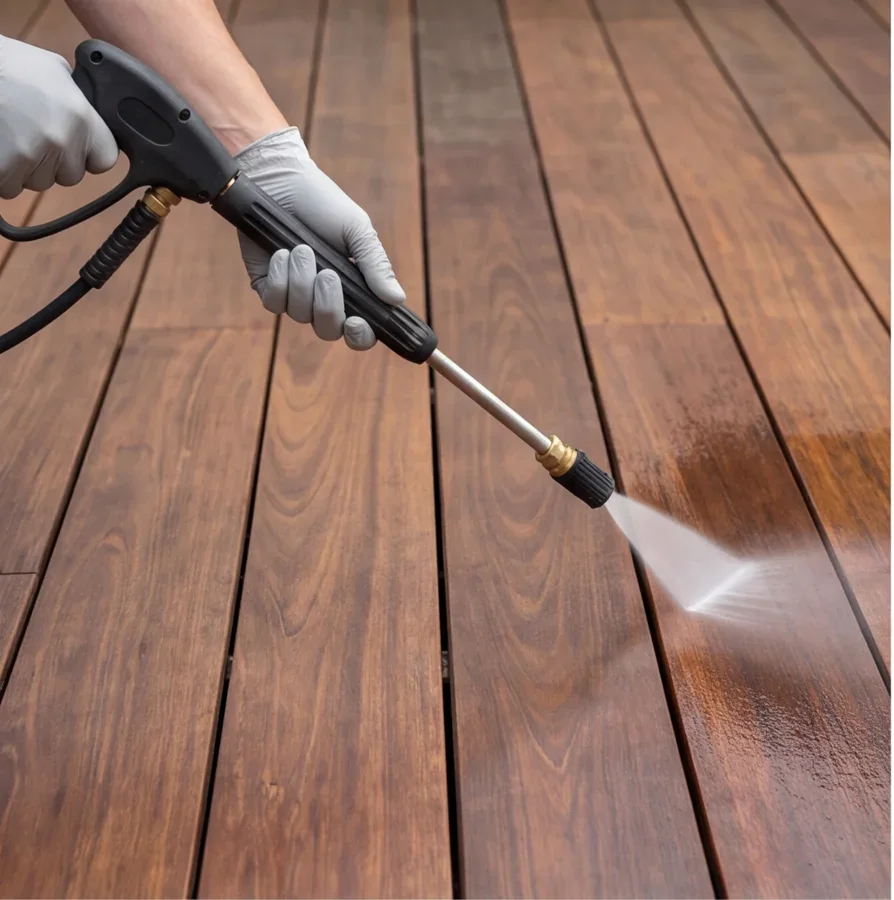
A fan-shaped water spray directed across a wood deck surface.
Illustrative care scenario. It does not prescribe pressure, chemistry, drying time or establish a safe condition for a real deck.CONTROLLED / PROBLEM APPROACH
Change the method.
See what matters.
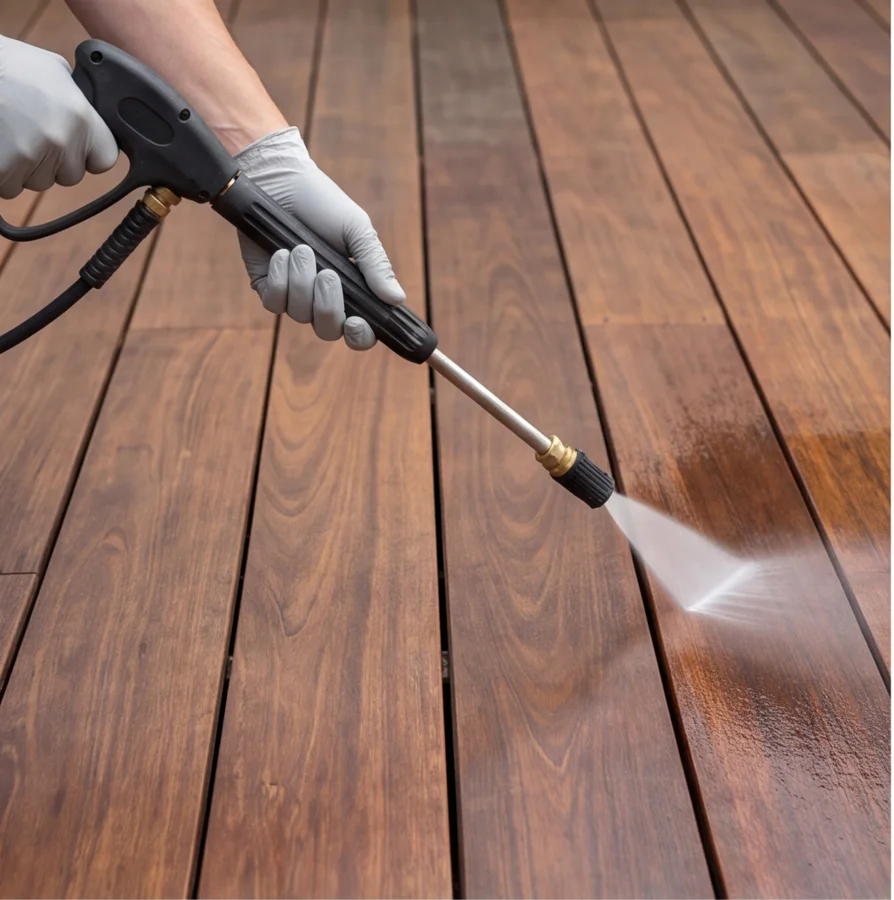
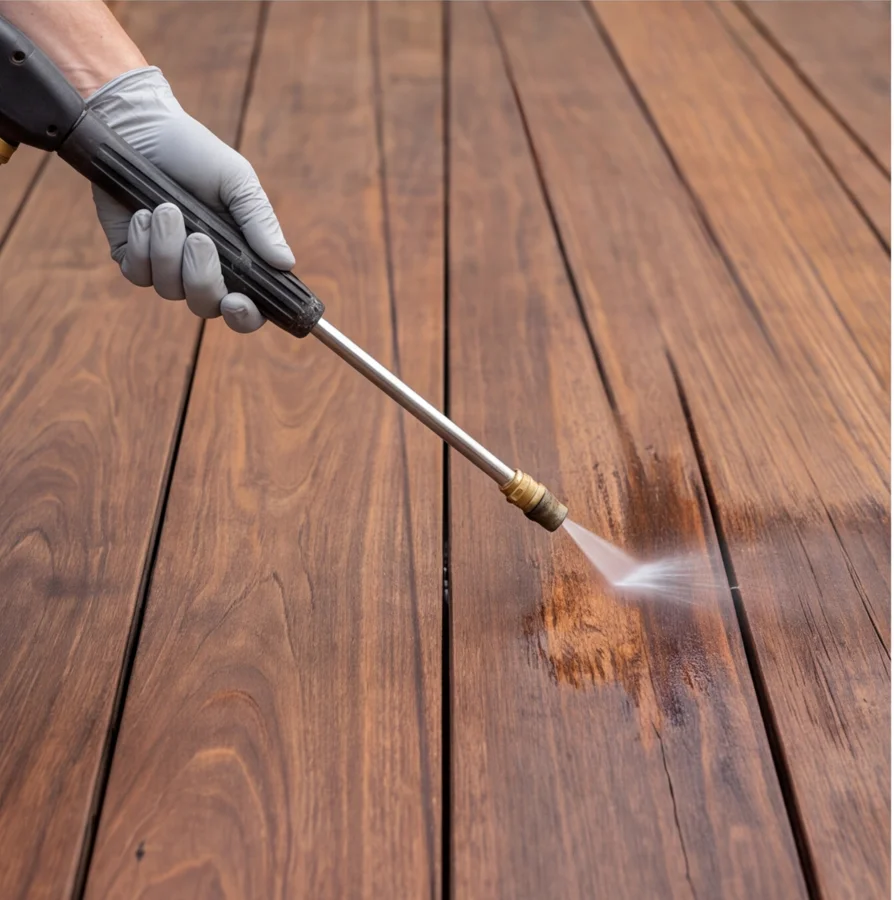
Visualization · Reference-matched surface scenarios. Appearance is illustrative; this is not a measured before-and-after project.
Pressure is not the whole method
Controlled: A controlled test with a compatible method, suitable fan and working distance.
Problem: Concentrated close pressure can mark or disrupt the surface.
No universal pressure or nozzle distance is prescribed here. Follow the equipment, cleaner and decking guidance, then inspect the fully dry test.
Other mistakes to investigate
- Uneven sanding: verify preparation before extending a trial.
- Trapped moisture: fix the wetting source and verify readiness.
- Incompatible treatments: identify old and proposed products before combining steps.
- Ignored metal staining: investigate the connection and water pathways, not only the color.
Check whether it is appropriate
Review the decking and coating instructions before choosing pressure washing. A nozzle setting does not describe the whole treatment: distance, angle, flow, dwell and operator movement also affect the surface. This site does not provide one safe pressure for every species, condition and machine.
Protect the surrounding assembly
Consider where water, debris and cleaner will travel. Gaps may direct water toward a wall, occupied space or electrical equipment. Identify runoff containment and protection requirements from the products and the project. Avoid using pressure to investigate soft material or to force water into joints.
Use a test and stopping criteria
Evaluate a complete dry test area for erosion, raised fibers, streaks and damage to coatings or adjacent materials. If the method changes the surface beyond the desired outcome, stop. More time or pressure can make repair and later preparation harder. A compatible low-aggression method may be the better starting point.
Separate cleaning from removing a finish
Write down the intended result before choosing equipment. Removing loose dirt, removing a failed coating and changing the appearance of weathered wood are different jobs. A pass that removes visible colour may also have removed part of the surface; colour alone cannot tell you whether the treatment was successful.
The USDA Wood Handbook, chapter 16, discusses surface erosion from aggressive power washing. Its finish-removal section explains that forcing off tightly bonded paint can deeply erode wood and leave ridges. This is background on the risk, not an operating setting for your deck. Use the selected decking, coating and equipment instructions to establish an appropriate method.
If the existing coating is unidentified, resolve that before choosing a removal method. Suspected hazardous coatings need an appropriate assessment and removal plan. A small cleaning test does not establish that an unknown coating is safe to disturb.
Record enough detail to repeat or reject the test
Identify the test location on a simple deck sketch and photograph it before treatment. Keep an adjacent untreated comparison where practical. Record the actual method used, including any cleaner, rather than writing only “pressure washed.” The entries below are record fields, not recommended settings.
| Record field | Useful entry | Why it matters |
|---|---|---|
| Location and starting condition | Board or zone identifier; dated photograph | Avoid comparing different areas as if they were one test |
| Material and coating | Known product references or explicitly unknown | Keep assumptions visible |
| Equipment and method | Machine, nozzle, setting, distance and pass technique used | A machine setting alone does not describe the treatment |
| Cleaner if used | Exact product and label instructions followed | Do not mix an unnamed chemical into the record |
| Surroundings | Runoff route and protection arrangements | Include effects beyond the treated board |
| Dry observation | Texture, remaining coating, streaks and adjacent surfaces | Do not judge only the wet appearance |
| Decision | Accept the method, revise the proposal or stop; responsible person | Make the next step explicit |
Keep the same observation location and use comparable lighting for the follow-up photograph. Record when the area was assessed and whether it was dry. Photographs can document appearance, but they do not establish coating readiness or the condition of concealed material.
Worked decision: cleaner is not necessarily better prepared
In a fictional test, a small patch loses visible dirt but develops a noticeably rougher texture than the untreated area. A second pass might make the colour more uniform while making the unwanted surface change harder to reverse. Record both outcomes: dirt removal improved, surface texture did not meet the intended result. Stop extending that method across the deck and review the proposal.
In another test, the dry surface appears acceptable but part of the previous finish remains. The next question is whether the intended finishing system permits that retained coating and what preparation it requires. The cleaning result does not answer that compatibility question. Keep the cleaner, existing coating and proposed finish references together when asking the product manufacturer for guidance.
Use the cleaning test-area guide for the broader test sequence. Save accepted and rejected tests in the maintenance record, including the reason for the decision. A rejected test is useful evidence: it helps the next operator avoid repeating an approach that did not meet the project’s objective.
A DECK-CARE SITUATION
A deck-care situation
Two strips receive the same machine setting but different nozzle distances. Their dry surfaces do not match. The test record includes distance and technique because the pressure number alone cannot reproduce a result.
Your review record
0 of 4 questions reviewed
A checked box records your review. It is not a professional approval.