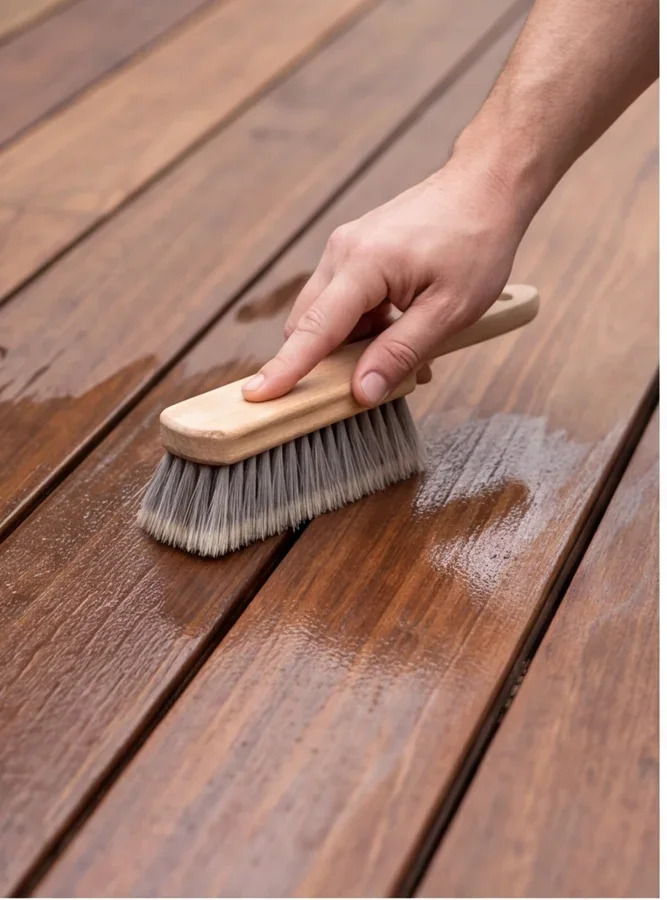
A hand using a bristle brush on a small area of wood decking.
Illustrative care scenario. It does not prescribe pressure, chemistry, drying time or establish a safe condition for a real deck.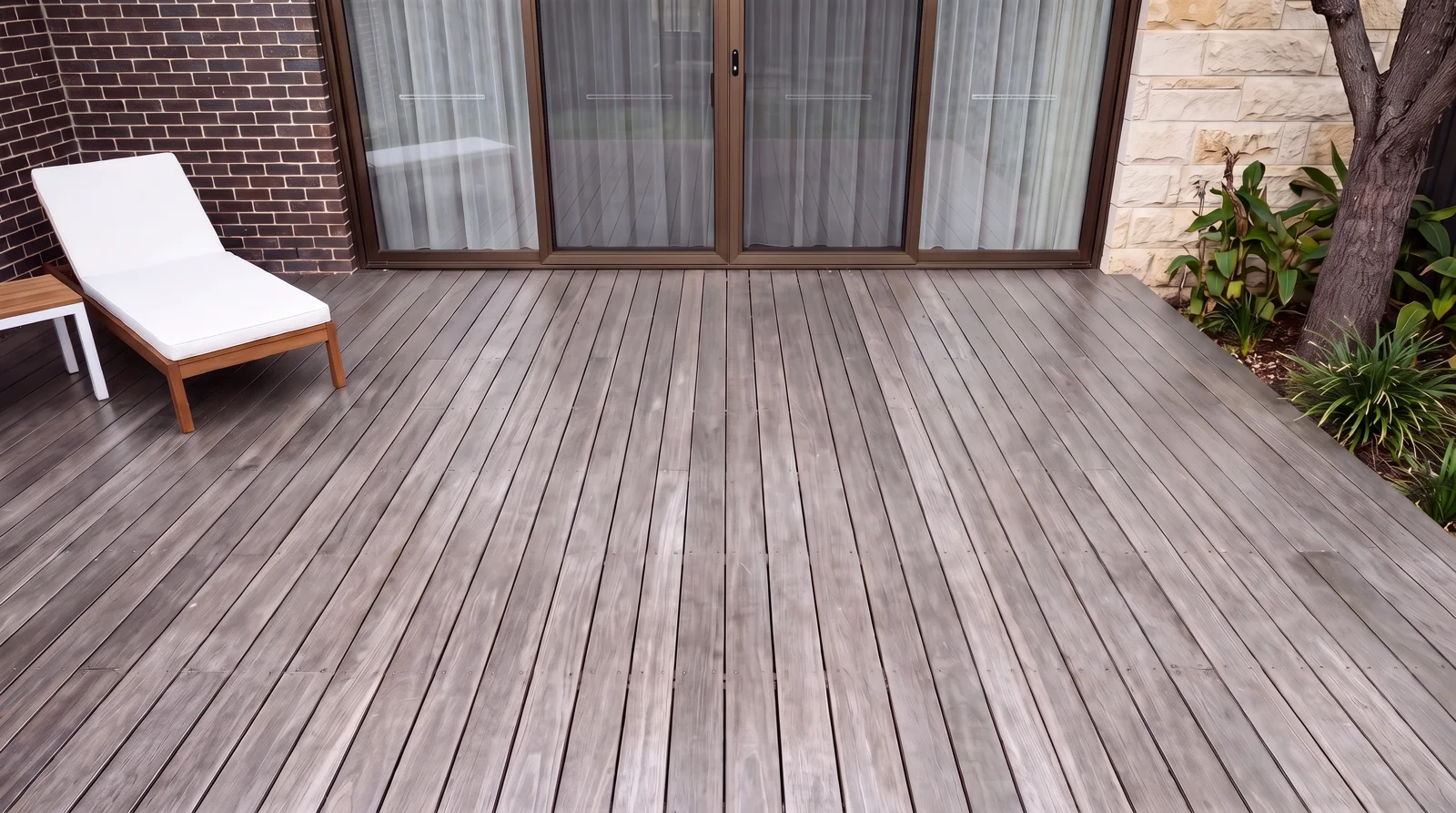
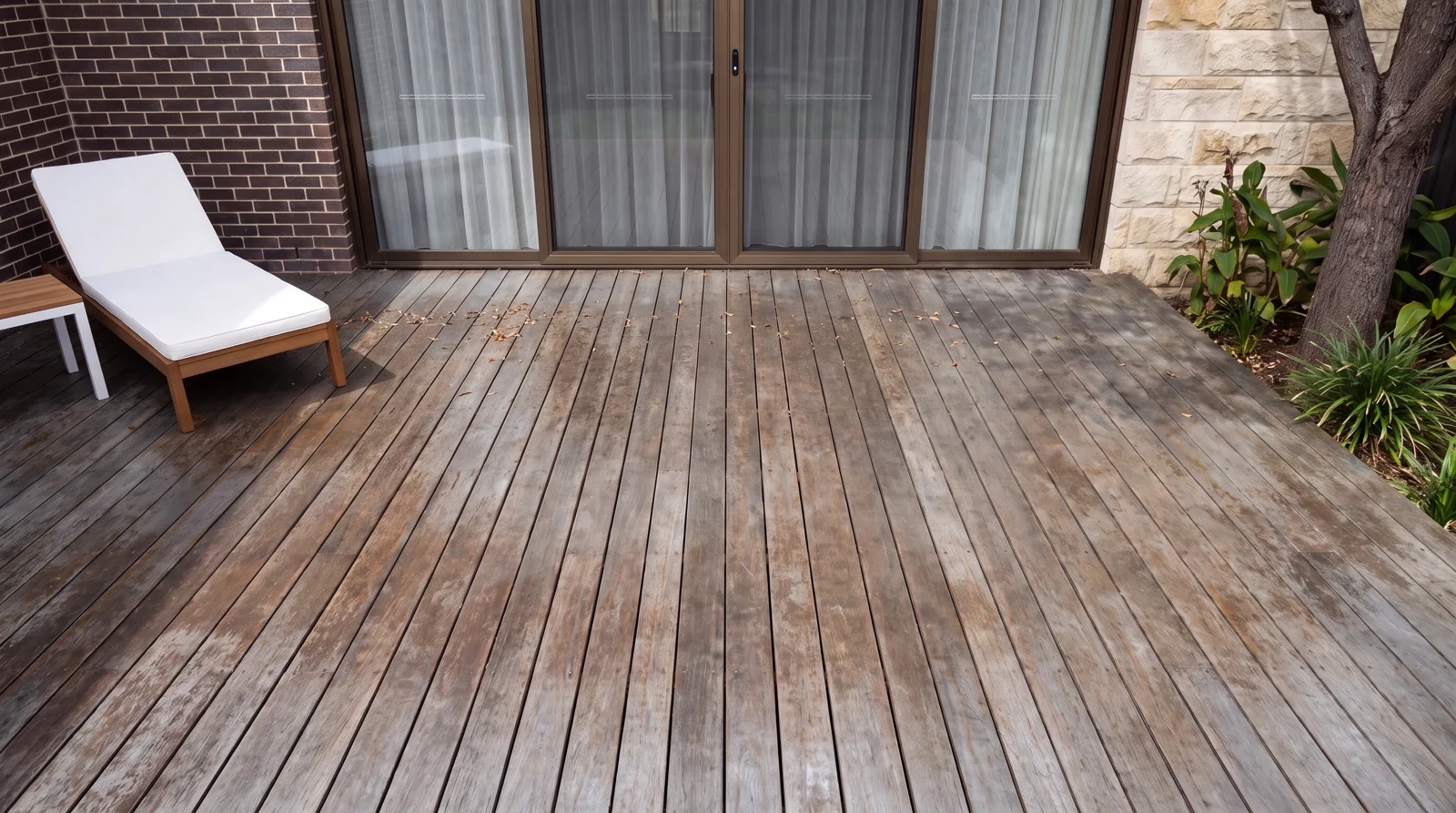
Visualization · Reference-matched surface scenarios. Appearance is illustrative; this is not a measured before-and-after project.
Define the outcome
Write down what you want to remove and what appearance you want to retain. Dirt, a failing coating, mineral staining and natural color change do not necessarily respond to the same treatment. Pick a representative but inconspicuous area. A sheltered corner may not represent the most weathered field boards.
Follow a complete sequence
Use a cleaner suitable for the actual substrate and existing coating. Read its label for preparation, dilution, contact time, agitation, rinsing and protection. Do not combine products or invent stronger concentrations. Include the intended drying period and, if applicable, the new finish in the test instead of judging only the wet cleaned surface.
Record before expanding
Record the product, dilution, tools, application conditions and dry result. Compare the trial with adjacent untreated material in similar light. If fibers lift, color changes unexpectedly or residue remains, stop and revisit the method. A more aggressive treatment is a new test, not an automatic next pass.
Give the test one question to answer
A cleaning test should help decide whether a proposed method removes the unwanted surface condition without an unacceptable change to the wood or adjacent materials. It should not combine several unfamiliar products and techniques at once. If the patch looks better or worse afterward, you need to know which method produced that result.
Choose a representative, limited area and an untreated comparison beside it. Include the condition you are actually trying to address: general soil, an old coating, a localized mark or another identified concern. A clean, sheltered corner is a poor test for a heavily exposed walking surface. Keep the test away from a location where runoff cannot be managed in accordance with the product instructions.
Establish the starting condition
Photograph the area dry before treatment. Note the known wood species, previous finish and recent care, leaving unknowns explicit. Check for issues that would make a surface-care trial inappropriate, such as a loose board or a condition requiring repair. Cleaning should not be used to cover over an unresolved safety concern.
Read the selected cleaner's current label and technical instructions before preparing the trial. Those documents control dilution, application, dwell time, rinsing, protective measures and compatible surfaces. Do not mix cleaners or add another chemical to correct an unexpected result unless the product manufacturer explicitly directs that procedure.
Keep the trial reproducible
| Test entry | What to record |
|---|---|
| Product | Exact name and current instruction reference |
| Preparation | Condition of the patch and any preliminary work |
| Application | Method and label-directed dilution, if applicable |
| Working conditions | Shade, temperature, wind and relevant weather |
| Rinsing | Method used under the product instructions |
| Assessment | Dry appearance, texture and remaining marks |
If two approved methods need comparison, use separately identified patches and keep the other conditions as similar as practical. Label the patches on a sketch or photograph. A memory of which brush or dilution was used is not sufficient when the deck is reviewed several days later.
Judge the dry result, not the dramatic wet photograph
Wet wood can look darker and more uniform than the final dry surface. Assess the patch again after it has reached the condition required for evaluation and any next treatment. Look for raised fibers, erosion, lap marks, persistent residue, uneven old finish and changes to adjacent surfaces. A cleaner-looking patch is not a success if the process has left a texture the owner cannot accept.
If the trial does not answer the original question, stop and identify what remains. A mark may be part of an existing finish, a chemical stain or a condition that ordinary cleaning will not resolve. Repeatedly increasing strength or pressure without a diagnosis can create a larger restoration problem.
Turn the result into a work decision
Record whether to proceed with the same method, revise the trial under the manufacturer's guidance, or seek a different assessment. If a coating will follow, confirm that the cleaning and preparation sequence is compatible with that exact finish. A successful cleaning patch does not automatically demonstrate coating adhesion or readiness.
The USDA finishing chapter provides the general relationship between wood condition, exposure and finish performance. Current product instructions control the trial itself. Continue with surface preparation when the next step is refinishing, or identify the existing finish when the previous coating remains uncertain.
A DECK-CARE SITUATION
A deck-care situation
A wet cleaning patch looks dramatically darker than the surrounding dry deck. The owner waits for the documented drying and review conditions before deciding that color has been restored. The final decision is based on the dry sample, not the temporary contrast created by water.
Your review record
0 of 4 questions reviewed
A checked box records your review. It is not a professional approval.