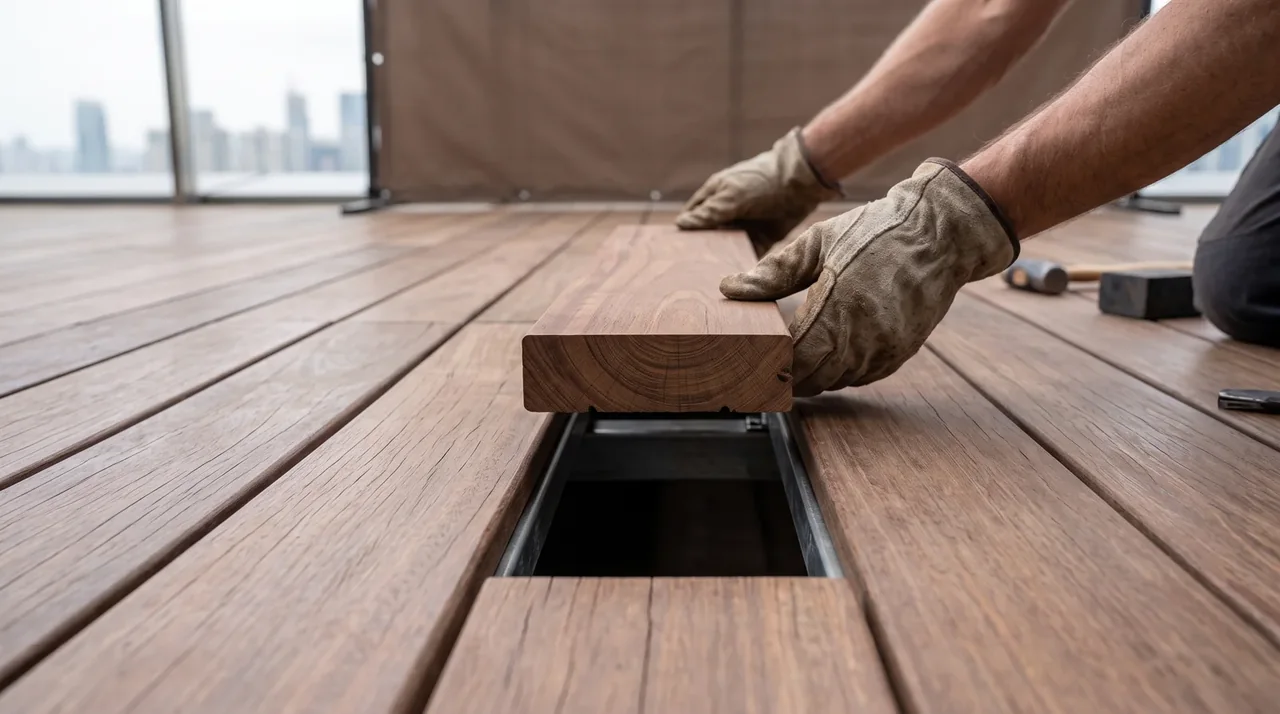
A deck board lifted over an opening for a replacement-work illustration.
Illustrative care scenario. It does not prescribe pressure, chemistry, drying time or establish a safe condition for a real deck.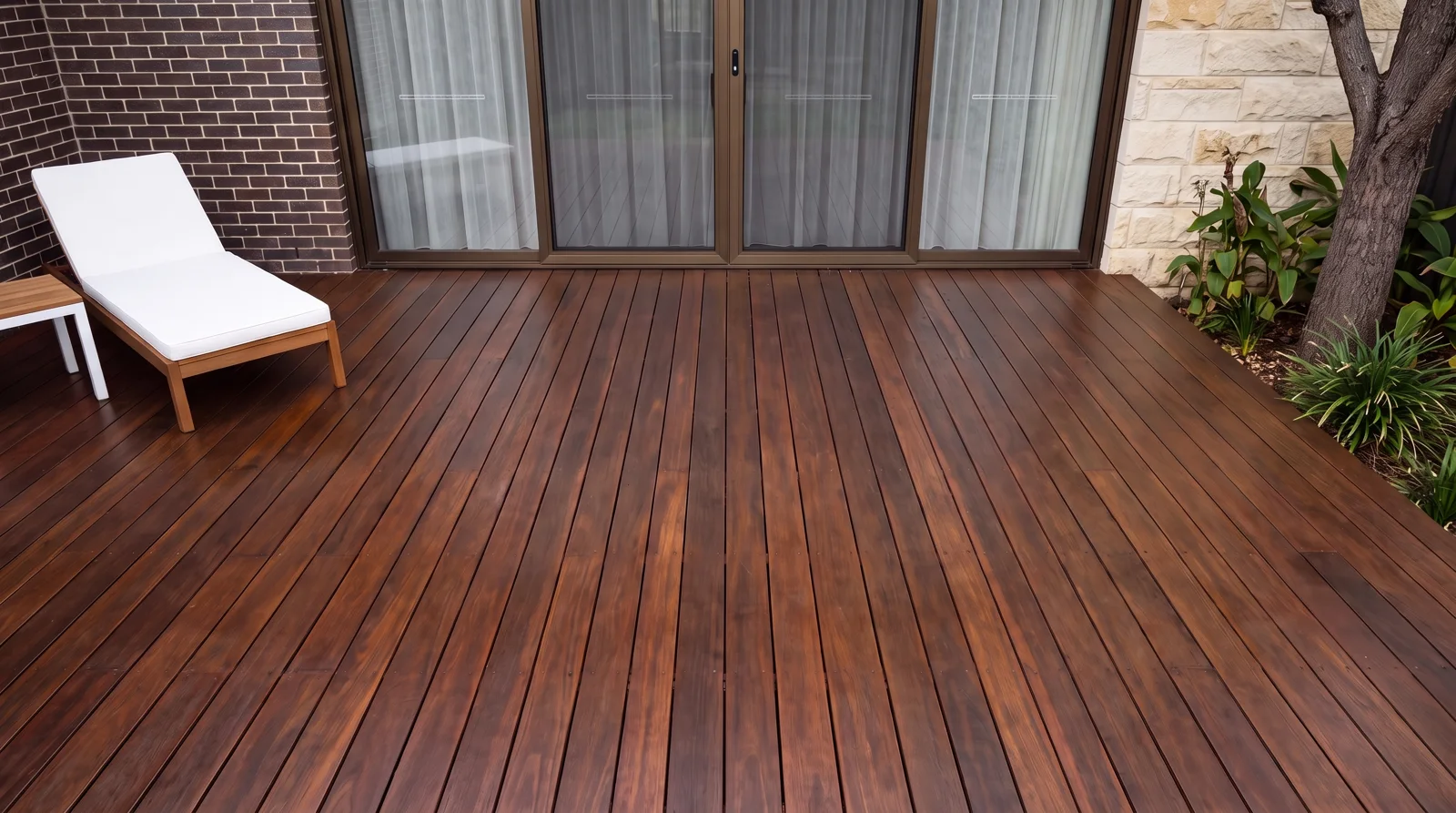
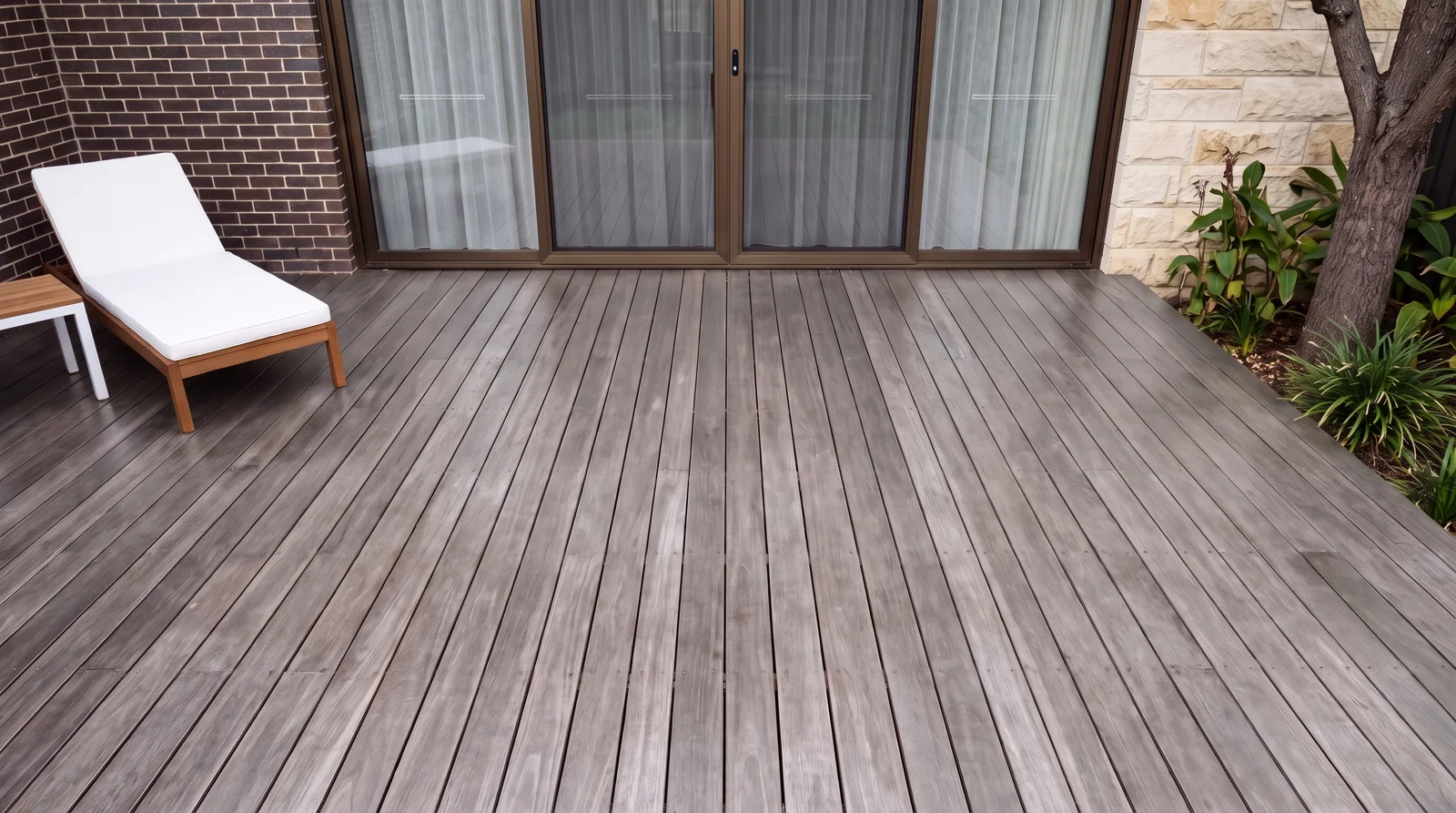
Visualization · Reference-matched surface scenarios. Appearance is illustrative; this is not a measured before-and-after project.
Define the problem being solved
A board replacement can address a localized defect without resolving the cause of repeated wetting. A full resurfacing can change appearance without correcting framing or connections. Ask which part of the assembly is affected and what evidence supports the proposed remedy.
Coordinate a replacement
Match the actual thickness, face, edge condition, fastening and support arrangement rather than only the species name. New boards can differ in color and exposure history from the remaining field. Discuss whether a transition, selected replacement zone or appearance tolerance is acceptable before purchasing.
Keep structural judgments on site
Suspected decay, loose guards, significant movement or failed connections require qualified assessment. Do not interpret a photo or a care-plan result as a repair design. After the underlying work is resolved, revise the cleaning and finish plan around the actual retained and replacement materials.
Separate surface work from a physical defect
Cleaning and refinishing address a surface-care objective. They do not restore a loose connection, establish the remaining capacity of a member or correct a defective support. Start by describing the problem in physical terms: a localized damaged board, a recurring loose edge, a widespread coating failure or another observed condition.
If there is a suspected safety or structural issue, keep people away from the affected area and arrange an appropriate on-site assessment. A photograph can help locate the concern but cannot establish that the deck is safe. Once the scope is understood, surface restoration can be planned around the repair rather than concealing it.
Identify the smallest complete repair scope
Replacing one visible board may require removing adjacent material or accessing a concealed fastener. The support below it may also need review. Determine what must be opened, what can be retained and how the replacement will connect before purchasing a single matching-looking piece. A narrow material quantity is not necessarily a narrow work scope.
For a replacement, retain the actual profile, thickness, face width, fastening interface and intended edge treatment. Nominal size and species name are insufficient to establish a match. A new board may also differ in colour and texture from the surrounding weathered surface even when the profile is correct. Discuss that appearance difference before work begins.
| Option | Appropriate question | Work easily overlooked |
|---|---|---|
| Clean and reassess | Is the issue limited to removable surface material? | Test patch and dry-condition review |
| Renew the finish | Is the existing system suitable for renewal? | Preparation and compatibility check |
| Replace selected boards | Can the local problem be resolved completely? | Access, fastening and surrounding disturbance |
| Replace the walking surface | Is a wider surface scope warranted? | Assessment of retained support and interfaces |
| Broader reconstruction | Does the assembly require more extensive work? | Teardown, disposal and coordinated rebuild |
Look for a recurring cause before repeating the repair
A replacement may reproduce the same problem if the moisture path, movement restriction or connection issue remains. Record the condition of the removed piece and the area it concealed. Preserve useful photographs before the opening is closed. A recurring local problem deserves an explanation of the assembly, not just another cosmetic treatment.
This does not mean every replacement requires a forensic investigation. It means the scope should answer why the affected part needs work and whether the conditions that caused the problem have been addressed. Where the cause remains uncertain, retain that uncertainty in the decision and seek the relevant technical review.
Finish the repair with a care handoff
Record the replacement product, location, date, preparation and finish applied. Identify any retained material and conditions that should be checked later. If the new board needs a different initial care sequence from the surrounding surface, keep those instructions distinguishable.
Compare proposals on the same repair scope, including access, removal, disposal, new material and labor. Long-term ownership modeling belongs in a separate cost study; this page is concerned with choosing and documenting the immediate care or repair task. Continue with condition before coating and the care record.
A DECK-CARE SITUATION
A deck-care situation
Replacing two boards with the same nominal size still leaves a mismatch if their finished thickness differs. The replacement schedule records actual dimensions and fastening access, while the owner reviews a sample for the likely appearance transition.
Your review record
0 of 4 questions reviewed
A checked box records your review. It is not a professional approval.